


I enjoy making clay rings because a small change in shape or color can give each one its own look.
For beginner jewelry makers, simple designs are a nice way to experiment without getting caught up in complicated details.
I’ve gathered ideas ranging from clean, minimal bands to rings with playful shapes and accents.
Here are 15 clay ring designs to inspire your next handmade accessory.
Multicolor Marbled Clay Ring

A hand-sculpted clay ring combines broad bands of terracotta, cream, and muted blue-green into a chunky, rounded accessory. The irregular color blocks make the surface visually striking while keeping the simple ring shape in focus.
The rounded profile gives beginners a straightforward form to adapt, and the color sections can be simplified or rearranged into stripes, patches, or a subtler two-color palette. Make the ring wider or slimmer to change its look, or use the same color-block idea on a pendant or small clay charm.
Sculpted Daisy Clay Ring

A hand-sculpted flower forms the centerpiece of this clay ring, with five rounded white petals around a raised yellow center and a gold-tone band. The simple, contrasting colors make the floral jewelry easy to recognize, while the uneven petal contours keep it looking handmade.
The flower shape can be adapted into a smaller ring centerpiece or made with fewer, simpler petals for an easier project. Try changing the center and petal colors, or use the same daisy design for a clay charm or pin; its bold silhouette makes it a clear, save-worthy idea for anyone collecting handmade ring inspiration.
Strawberry Clay Ring

A tiny strawberry tops this handmade clay ring, turning a simple band into a playful fruit-themed piece of jewelry. The green leaves and red berry give it a clear color contrast, while the small sculpted seeds make the focal detail recognizable.
The strawberry could be scaled down for a subtler ring or made larger for a bolder statement, and the band could be adjusted to suit different sizes. For a simpler version, use a plain red berry shape with a single green leaf, or adapt the fruit motif into a miniature charm.
Textured Blue Clay Statement Ring

A hand-sculpted clay ring pairs a broad, rounded rectangular blue top with a copper-colored band, creating a bold piece of handmade jewelry. The softly irregular edges and mottled, faceted surface give the solid shape visual texture without adding extra decorative motifs.
The oversized top makes the ring memorable, and you could adapt the idea with a smaller form, a more oval silhouette, or a different color for the clay and band. For a simpler version, keep the shape smooth and add just a few shallow marks; making the top in several sizes could also turn the concept into coordinating pendants or charms.
Terrazzo-Style Clay Statement Ring

A handmade clay statement ring pairs a chunky rounded band with a large oval top scattered with irregular pastel and dark-colored pieces. The contrast between the creamy base and the varied shapes gives this jewelry idea its terrazzo-style look, while the visible hand-shaped contours keep it from feeling perfectly uniform.
The oversized top makes the pattern easy to customize: use fewer, larger pieces for a bolder look or smaller shapes in a limited color palette for a subtler ring. You could also adapt the same design to a pendant or a smaller ring top, keeping the scattered-color motif as the main detail.
Red-and-White Mushroom Clay Ring
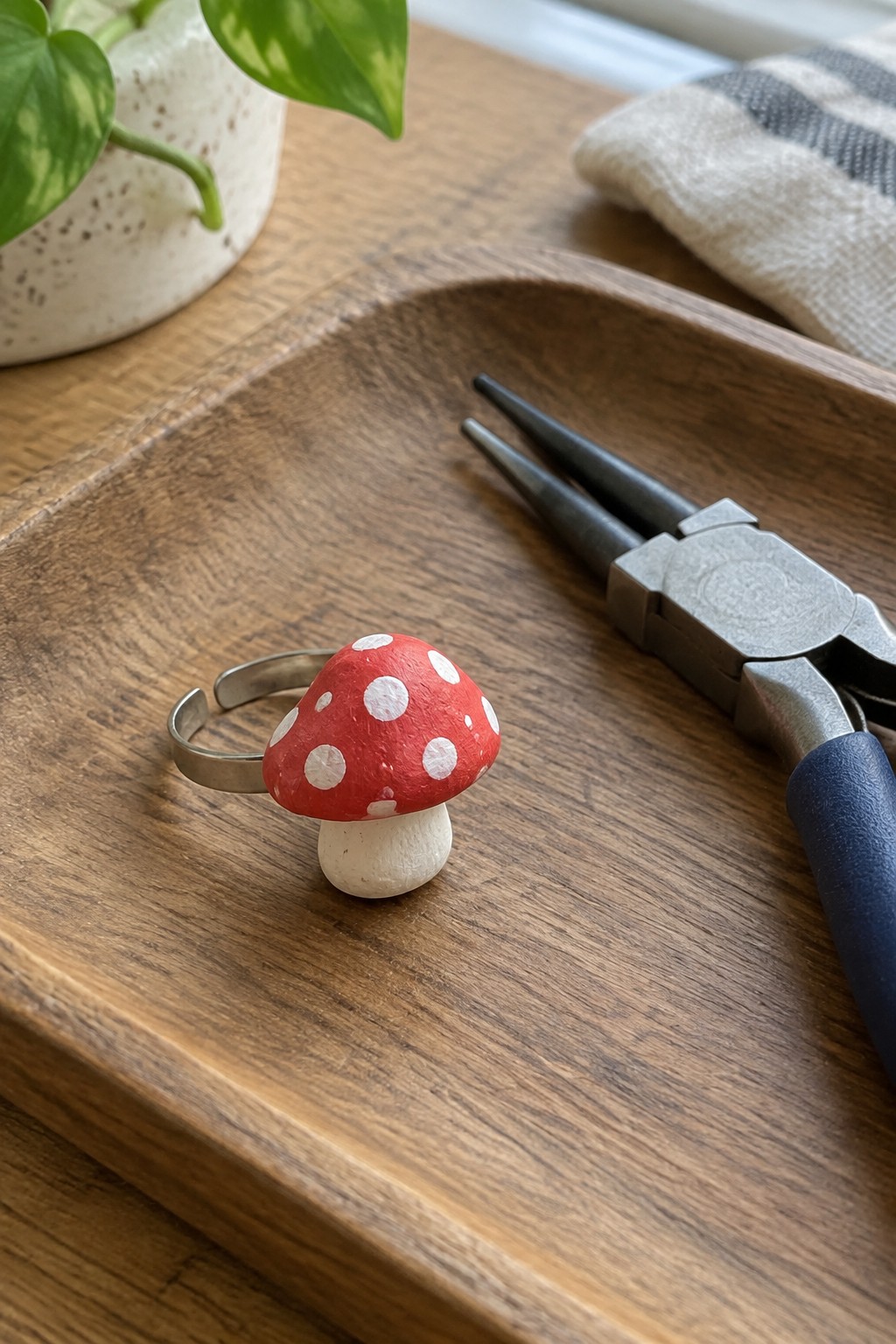
A sculpted mushroom forms the focal point of this handmade clay ring, with a rounded red cap, white spots, and a short cream-colored stem. The small figurine is attached to a metal ring base, turning a familiar woodland motif into a playful piece of wearable jewelry.
The rounded cap makes the design easy to recognize, while the spots provide a simple detail that can be varied in size or placement. You could make the mushroom smaller for a more understated ring or try different cap colors and patterns; a simplified cap and stem would also carry the idea into a pendant or charm.
Black Clay Ring With a Sculpted Triangle

This handmade clay ring pairs a simple rounded band with a raised triangular detail at the front. Its matte black color keeps the sculpted silhouette and open center of the triangle in focus, making it a distinctive piece of clay jewelry without extra decoration.
The shape does the work here, so a simpler version could use a plain band and a single raised geometric accent. Try changing the triangle to a circle, arch, or small heart, or make the detail in a contrasting clay color; the same idea could also be adapted into a pendant or charm.
Pastel Cloud Clay Statement Ring

A sculpted cloud forms the oversized top of this handmade clay ring, blending soft blue and pink across its rounded contours. The organic silhouette and color transition make the ring a small, decorative statement accessory rather than a simple band.
The cloud shape is easy to adapt by changing its size, outline, or color blend, and a beginner could simplify it to a few rounded lobes in two solid colors. Try a smaller version for a more subtle ring or use the same cloud motif as a clay charm or ornament.
Pink Sprinkle Donut Clay Ring

A miniature donut forms the centerpiece of this handmade clay ring, with pink icing and colorful sprinkle details sculpted over a rounded tan base. The playful dessert motif turns the ring into a small, decorative piece of novelty jewelry, and the layered colors make its shape easy to recognize.
The donut’s simple round form makes the idea easy to adapt: use a different icing color, change the sprinkles, or make the topping less detailed for a simpler version. You could also scale the motif down for a charm or create several rings with different miniature dessert designs.
Miniature Clay Flower Bouquet Ring
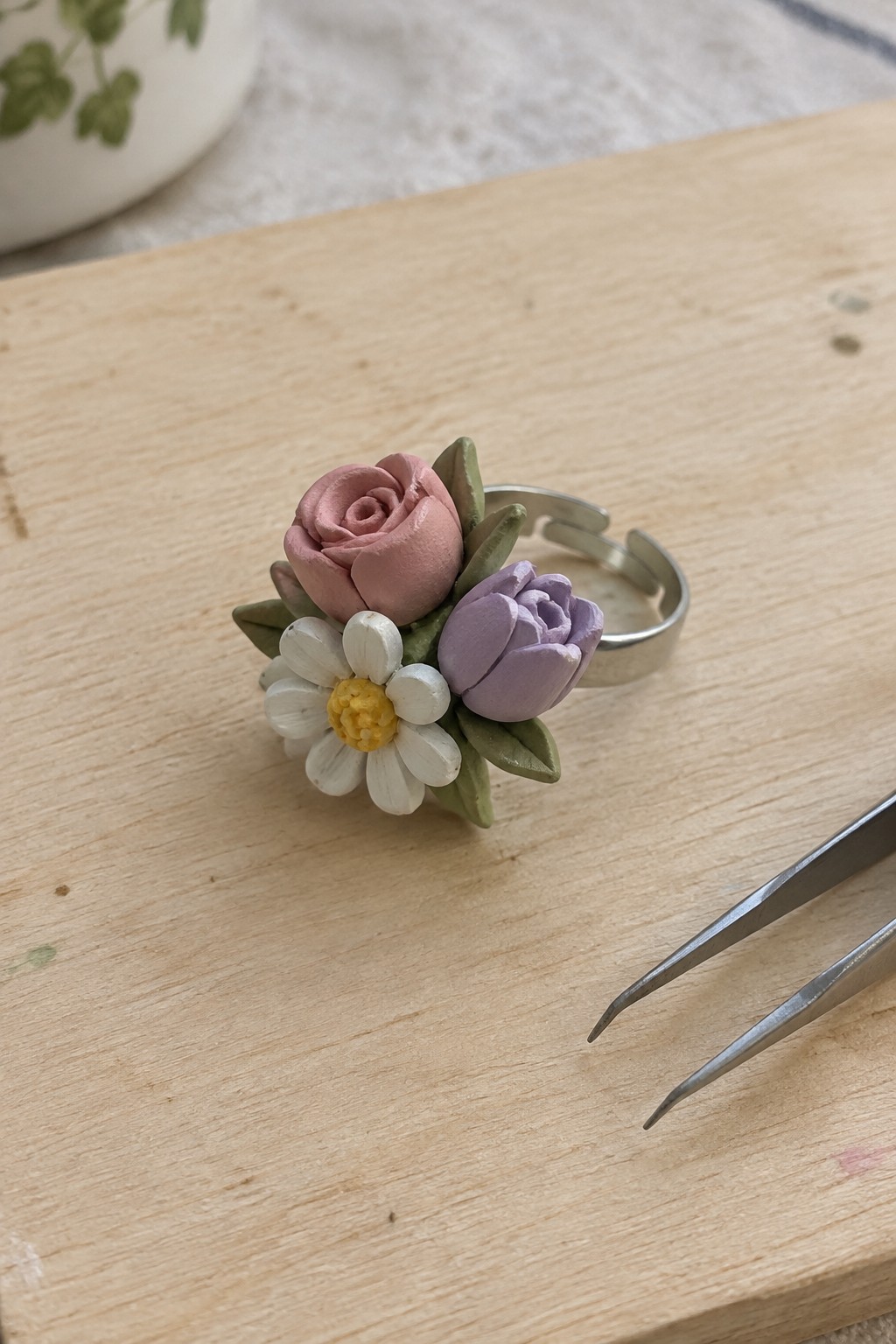
A miniature floral bouquet turns a simple ring band into a sculpted clay jewelry piece. A pink rose, lavender tulip, and white daisy sit among muted green leaves, with their rounded petals adding contrast and dimension to the small design.
The clustered arrangement makes the ring memorable, and you could simplify it by sculpting one flower with a few leaves before trying a full bouquet. Changing the flower shapes or using brighter colors would give each version a different look, while a smaller cluster could make a more understated accessory.
Tiny Cat Face Clay Ring

A tiny sculpted cat face turns this handmade clay ring into a playful animal-themed accessory. Its cream-colored face, pointed ears, small pink nose, and dark whisker details make the miniature shape easy to recognize, while the simple band keeps the design wearable.
The small scale makes this idea easy to adapt with different animal faces, ear shapes, or colors, such as a gray cat or a brown bear. For a simpler version, use a rounded face and just a few painted features, or make the sculpted face as a charm instead of attaching it to a ring band.
Terracotta Oval Clay Statement Ring

A hand-sculpted oval clay centerpiece gives this ring a simple, earthy statement look, with its warm terracotta color and softly irregular edges providing the main detail. The solid clay shape contrasts with the slim brass-tone band, making the design a piece of wearable clay jewelry rather than a miniature sculpture or home decoration.
The oval can be made larger or smaller to change how bold the ring looks, and a beginner could keep the surface plain or add a few incised lines or painted marks. Earthy shades such as rust, cream, or olive would suit the sculptural shape, while making several different ovals offers an easy way to create a coordinated set.
Stacked Color-Block Clay Rings

These handmade clay rings use three rounded bands in mustard yellow, muted teal, and pale pink, with narrow contrasting stripes crossing each band. The stacked form and simple color blocking make the set a playful clay jewelry idea without relying on detailed sculpting.
The slim bands are easy to adapt with different color pairings or stripe placement, and a simpler version could use solid-color rings with just one contrasting accent. Make them as a coordinated set or vary the band widths and colors for individual statement rings.
Sea Glass Shell Clay Statement Ring

A sculpted shell-shaped clay piece turns a simple adjustable band into a coastal statement ring. Its raised fan-like ridges and weathered blue-green and sandy tones give the handmade surface depth without needing extra embellishments.
The oval shell silhouette is easy to adapt into a smaller ring or a pendant, and the ridges can be simplified into a few main lines for a less detailed version. Try different muted blues, greens, or warm neutrals to change the look while keeping the shell motif distinctive.
Clustered Pink Heart Clay Ring

A copper-tone adjustable band topped with several hand-sculpted pink hearts makes this a playful clay statement ring. The overlapping hearts have rounded, slightly uneven contours, giving the small jewelry piece a soft sculptural look rather than a flat, stamped design.
The clustered shapes are the main feature, so you could simplify the idea by using just one large heart with a smaller one beside it. Try different heart sizes or a palette of red, lavender, and pale pink, and adapt the same motif into a pendant or decorative charm.
Frequently Asked Questions
Polymer clay is usually the easiest choice for beginner clay rings. It’s soft, comes in many colors, and hardens in a home oven when baked according to the package instructions. Air-dry clay is another option, but it may be more fragile and is not always suitable for jewelry that gets frequent wear. Check the clay’s instructions before starting, and never bake it above the recommended temperature.
You can get started with just a few basic supplies: polymer clay, a smooth work surface, a craft blade, and a ring mandrel or another smooth cylindrical object for shaping. A ruler or clay roller can help make even coils and bands. For a polished finish, use fine-grit sandpaper after baking. If you plan to add metal findings or a topcoat, make sure they are compatible with polymer clay.
Measure the circumference of the finger where you’ll wear the ring, then compare it with a ring-sizing chart. Make the clay band slightly larger than your target size because clay may shift as you shape it. You can test the fit by wrapping the unbaked band around a ring mandrel or a smooth object of the appropriate size. Avoid making the band too tight, since fingers can swell during the day.
Keep the band’s thickness even, avoid very thin areas, and smooth out cracks before baking. Follow the clay manufacturer’s baking time and temperature precisely, using an oven thermometer if possible because household ovens can run hot or cold. Let the ring cool completely before handling it. For designs with raised decorations, press the pieces firmly into the band and consider reinforcing delicate shapes with a suitable adhesive after baking.
Yes. You can blend small amounts of clay to create new colors, or layer contrasting colors for stripes, dots, marbling, and simple floral designs. Add decorations while the clay is still soft so they attach securely. Keep embellishments small and balanced to reduce the chance of snagging or breaking. If you use paint, glitter, or a sealant, check that it is suitable for polymer clay and follow its directions.
